2027 Family Grocery Budget Guide Using Official USDA Food Plans
Benchmark your 2027 weekly and monthly grocery budget using Official USDA Food Plans (Thrifty to Liberal), household scaling, and our free Meal Planner PDF.
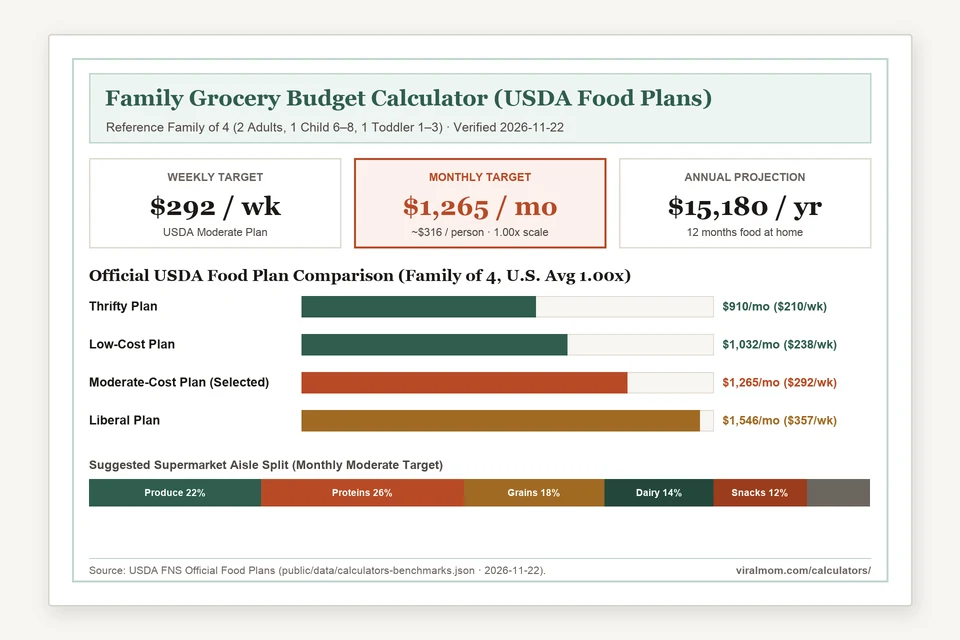
Every parent standing at the supermarket checkout lane asks the same quiet question: "Are we overspending on groceries, or does feeding a family simply cost this much now?" Online advice makes the confusion worse—one viral video claims a family of six eats on $400 a month while another insists $2,000 is barely enough. Neither helps you build a calm, sustainable 2027 household budget.
That is why anchoring your food plan to the Official USDA Food Plans published by the U.S. Department of Agriculture Food and Nutrition Service (FNS) is so liberating. Rather than guessing, you can benchmark your household’s exact age brackets, apply USDA’s official household-size scaling multipliers, adjust for regional store prices, and translate your monthly target into a repeatable weekly meal sheet.
2027 USDA Food Plan Reference Benchmarks (Verified 2026-11-22)
The USDA publishes four nutritious, home-prepared food plans—Thrifty, Low-Cost, Moderate-Cost, and Liberal—all of which satisfy federal Dietary Guidelines. The difference between tiers is not nutrition quality; it is convenience packaging, cuts of meat and seafood, organic preferences, and how much cooking you do from scratch.
Using ViralMom’s open benchmark dataset (public/data/calculators-benchmarks.json, last reviewed 2026-11-22 against USDA FNS monthly reports), here are the exact modeled monthly baselines per individual in a 4-person reference household, plus the summed total for a reference family of four (two adults ages 19–50, one child age 6–8, and one toddler age 1–3 at U.S. average 1.00× pricing):
| Household Member Bracket | Thrifty / mo | Low-Cost / mo | Moderate / mo | Liberal / mo |
|---|---|---|---|---|
| Toddler (Ages 1–3) | $146 | $168 | $205 | $248 |
| Preschooler (Ages 4–5) | $162 | $182 | $224 | $272 |
| Child (Ages 6–8) | $208 | $246 | $298 | $360 |
| Older Child (Ages 9–13) | $248 | $292 | $362 | $438 |
| Teenager (Ages 14–18) | $296 | $342 | $424 | $518 |
| Adult Woman (Ages 19–50) | $252 | $284 | $348 | $432 |
| Adult Man (Ages 19–50) | $304 | $334 | $414 | $506 |
| Adult (Ages 51+) | $248 | $286 | $352 | $434 |
| Ref. Family of 4 (2 Adults + 6–8 + 1–3) | $910/mo ($210/wk) | $1,032/mo ($238/wk) | $1,265/mo ($292/wk) | $1,546/mo ($357/wk) |
How Household Size & Regional Store Prices Shift Your Real Number
Two critical multipliers explain why a family of two in Boston and a family of six in Ohio cannot share the same per-person target. First, USDA publishes official economy-of-scale adjustments because base individual numbers assume a four-person household: 1-person homes multiply by 1.20× (+20%), 2-person homes by 1.10× (+10%), 3-person homes by 1.05× (+5%), 4-person homes by 1.00×, 5-to-6-person homes by 0.95× (-5%), and 7+ person homes by 0.90× (-10%).
Second, local supermarket pricing varies considerably by metro area. In our interactive Family Grocery Budget Calculator, households in lower-cost Midwest or Southern markets often test a 0.90× regional multiplier, suburban coastal families commonly test 1.15×, and high-cost metros test up to 1.30×. Applying both multipliers honestly keeps your 2027 budget realistic rather than setting an impossible cap you abandon by February.
| Supermarket Aisle / Category | Target Share | Weekly Cap | Monthly Cap |
|---|---|---|---|
| Fresh & Frozen Produce | 22% | $64/wk | $278/mo |
| Meat, Poultry, Fish, Eggs & Beans | 26% | $76/wk | $329/mo |
| Grains, Bread, Pasta & Pantry Staples | 18% | $53/wk | $228/mo |
| Dairy, Milk & Plant Alternatives | 14% | $41/wk | $177/mo |
| Lunchbox Snacks, Coffee & Beverages | 12% | $35/wk | $152/mo |
| Kitchen Paper Goods & Basic Supplies (Convenience Buffer) | 8% | $23/wk | $101/mo |
Step-Down Strategy: Moving One USDA Tier Lower Without Deprivation
Notice the gap between a Moderate-Cost budget ($1,265/mo) and a Low-Cost budget ($1,032/mo) for our reference family of four: $233 every month, or $2,796 over a full year. Even moving halfway between those two tiers frees up over $1,300 a year for a family emergency fund or summer vacation—without switching to joyless meals.
The secret is targeting the three highest-leakage habits instead of cutting fresh fruit or clipping twenty coupons for processed boxed snacks you never needed:
- Anchor 5 dinners around weekly loss-leader proteins and lock in one dedicated "Pantry & Leftovers Reset Night" every Thursday so perishable produce never rots in the crisper.
- Split produce purchases into Early-Week vs. Late-Week vegetables: serve delicate berries, spinach, and cucumbers Monday–Wednesday, and roast sturdy carrots, cabbage, potatoes, and frozen broccoli Thursday–Sunday.
- Order staples via free grocery curbside pickup when shopping tired with hungry kids—eliminating impulse endcap adds routinely protects your weekly target immediately.
- Keep restaurant takeout, coffee drive-thrus, diapers, and pet food in a separate household budget category so you always compare true apples-to-apples food-at-home spending against USDA plans.
Turn Your Monthly USDA Target Into a 10-Minute Sunday Ritual
A monthly spreadsheet only works when it meets your kitchen counter on Sunday afternoon. Follow a simple two-tool loop: first, calculate your exact household weekly target in our USDA Family Grocery Budget Calculator (remember: Weekly Budget = Monthly Budget × 12 ÷ 52). Second, type that weekly cap into our free Printable Weekly Meal Planner & Grocery Budget PDF, plug in seven realistic dinners, list ingredients under four aisle caps, and pin the sheet straight to your refrigerator.
Write down your actual receipt total in the bottom Planned-vs-Actual box after shopping. After just four weeks of seeing planned versus actual spend side by side, you will spot your household’s exact patterns and feel genuinely in control of 2027 food costs.
Step 1 · Calculate Your Exact USDA Target
Run Our Official USDA Family Grocery Budget Calculator
Enter your exact family ages, test regional cost multipliers, compare all 4 USDA Food Plan tiers, and export a printable Monthly Grocery Plan PDF.
Your 2027 Grocery Budget Reset Action Plan
- 01 Separate last month’s bank/card receipts into "Food at Home" vs. "Dining Out & Non-Food Household Supplies."
- 02 Run your family’s exact age brackets and regional index in our USDA Family Grocery Budget Calculator.
- 03 Choose a realistic starting USDA tier (most dual-working families thrive between Low-Cost and Moderate).
- 04 Transfer your weekly target into our Weekly Meal Planner & Grocery Budget PDF every Sunday afternoon.
- 05 Schedule one Thursday "Pantry & Leftovers Night" every week to protect produce savings.
Primary Sources & Editorial Verification
How ViralMom Verifies Sources →- USDA Food and Nutrition Service (FNS) — Official USDA Food Plans: Cost of Food Monthly Reports (Verified 2026-11-22)
- ViralMom Open Calculator Benchmarks Dataset (JSON) (Verified 2026-11-22)
Frequently Asked Questions
What is a realistic monthly grocery budget for a family of four in 2027?
Using our USDA-calibrated reference family of four (two adults 19–50, one child 6–8, one toddler 1–3, U.S. average pricing, verified 2026-11-22), Official USDA Food Plans range from $910/mo (Thrifty) and $1,032/mo (Low-Cost) to $1,265/mo (Moderate) and $1,546/mo (Liberal). High-cost coastal metros often run 15%–30% higher.
Do USDA Food Plan budgets include toilet paper, diapers, or takeout?
No. Official USDA Food Plans assume 100% of meals and snacks are purchased at food stores and prepared at home. Track restaurants, diapers, pet food, and household toiletries separately (our calculator adds an optional 8% basic kitchen paper buffer for convenience).
Why does a 2-person household cost more per person than a 5-person household?
USDA applies economy-of-scale multipliers (+10% for 2 people vs. -5% for 5–6 people) because smaller retail packages carry higher per-ounce costs and higher produce spoilage rates than bulk family packs.
How do I connect my USDA grocery target to weekly meal planning?
Take your calculated weekly figure from our Family Grocery Budget Calculator and enter it as the Weekly Cap inside our free Printable Weekly Meal Planner & Grocery Budget PDF so every dinner and aisle item stays within budget.