Daycare vs. Stay-at-Home Cost Checklist Using Official U.S. DOL Benchmarks
Compare working with daycare vs. staying home using official U.S. DOL childcare benchmarks, marginal tax math, 401(k) match, and Dependent Care FSA rules.
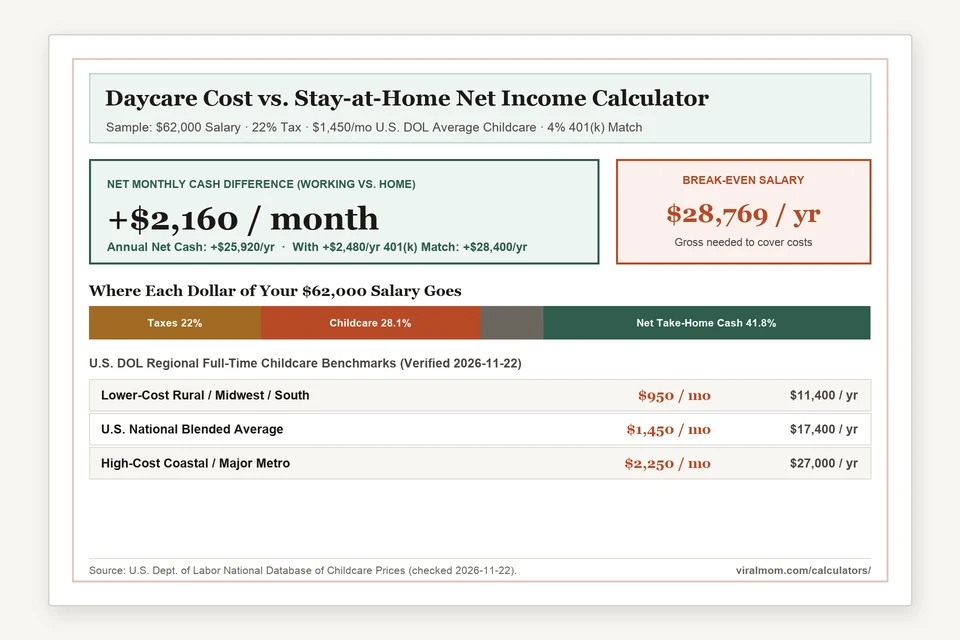
Writing a four-figure monthly daycare check makes almost every working parent pull out a napkin and wonder: "Am I working forty hours a week just to pay for childcare?" Because full-time center tuition for an infant or toddler rivals a mortgage payment in many U.S. counties, gut-level frustration often tempts families to look only at net paycheck minus daycare bill—and miss half the real financial equation.
This decision checklist walks step by step through every cash outflow, hidden career benefit, tax offset, and hybrid work option using official U.S. Department of Labor childcare cost benchmarks so you and your partner can make a clear, confident choice.
Official U.S. DOL Regional Childcare Cost Tiers & Break-Even Math
Childcare pricing varies dramatically by county and child age (infant rooms require tighter teacher-to-child ratios than preschool rooms). Grounded in the U.S. Department of Labor National Database of Childcare Prices & Child Care Aware planning tiers documented in our open dataset (public/data/calculators-benchmarks.json, verified 2026-11-22), here are the three U.S. regional benchmarks for one child in full-time center care—and the exact break-even gross salary required solely to cover childcare at a 22% combined marginal tax rate (before adding commuting or workday costs):
| Regional Cost Tier (U.S. DOL Basis) | Monthly Center Care (1 Child) | Annual Childcare Total | Break-Even Gross Salary (at 22% Tax, Care Only) |
|---|---|---|---|
| Lower-Cost Rural / Midwest / South | $950 / mo | $11,400 / yr | $14,615 / yr |
| U.S. National Blended Average | $1,450 / mo | $17,400 / yr | $22,308 / yr |
| High-Cost Coastal / Major Metro | $2,250 / mo | $27,000 / yr | $34,615 / yr |
The 7-Line True Comparison Checklist (Do Not Skip Lines 5–7)
Most hasty spreadsheets stop at Line 3. Walking cleanly through all seven lines below reveals both your spendable checking-account cash flow today and your total household wealth over the next five years.
| Audit Line | Direction | What to Enter Accurately | Common Mistake to Avoid |
|---|---|---|---|
| 1. Marginal Income + FICA Taxes | Outflow (Working) | Combined federal marginal bracket + state income tax + 7.65% Social Security/Medicare. | Using your single effective rate instead of the stacked dual-earner marginal bracket. |
| 2. Full-Time or Part-Time Childcare | Outflow (Working) | Actual local quotes across daycare center, licensed home daycare, or nanny share (all kids). | Forgetting summer camp or after-school care costs once older kids enter kindergarten. |
| 3. Commute & Vehicle Wear | Outflow (Working) | Monthly gas/charging, transit pass, tolls, parking, and incremental car insurance/maintenance. | Ignoring parking garage fees or second-car loan/insurance costs that could drop if home. |
| 4. Workday Convenience Creep | Outflow (Working) | Office lunches, grab-and-go coffee, dry cleaning, and extra takeout on exhausted weeknights. | Assuming a stay-at-home parent spends $0 on toddler outings, gas, or home utilities. |
| 5. Employer 401(k) Match | Wealth Gain (Working) | Free employer retirement match (e.g., 4% of $62,000 = $2,480/yr immediately invested). | Leaving employer match out because it does not hit your checking account this Friday. |
| 6. Health Insurance Subsidy | Wealth Gain (Working) | Annual premium difference if your employer offers markedly cheaper family health coverage. | Skipping open-enrollment quotes for moving onto a spouse’s plan before resigning. |
| 7. Tax Offsets (DCFSA / CDCTC) | Tax Relief (Working) | Pre-tax Dependent Care FSA (federal cap $7,500/household or $3,750 MFS effective Jan 1, 2026 under P.L. 119-21, plan-dependent) or Child & Dependent Care Credit. | Forgetting to ask HR whether your employer’s DCFSA plan adopted the higher 2026 statutory limit. |
Remember the Temporary Daycare Cliff vs. Long-Term Career Curve
Peak childcare spending is painful—especially when two siblings under age four overlap in full-time care—but it has a built-in expiration date. For most U.S. families, the heaviest daycare bill lasts three to five years until public pre-K or kindergarten begins. Even if near-term monthly cash flow looks nearly break-even during a two-toddler stretch, staying connected to paid employment preserves annual cost-of-living raises, employer 401(k) compounding, and uninterrupted Social Security earning credits.
Conversely, staying home carries real, meaningful household value that spreadsheets cannot quantify: unhurried mornings, flexibility during inevitable preschool sick weeks, lower convenience-food spending (moving down a USDA grocery tier from Moderate to Low-Cost saves $233/month for a reference family of four!), and priceless time during the early years. Neither choice is universally "right"—the goal is making an intentional, numbers-clear choice with zero surprise shortfalls.
Four Hybrid Middle-Ground Paths Families Overlook
Before treating the decision as strictly full-time commuting versus zero earned income, run a third scenario in our calculator testing one of these four middle paths:
- Negotiate 2–3 remote days or a 32-hour (0.8 FTE) schedule with your current employer—trimming commute expenses and switching to part-time preschool while retaining benefits and career continuity.
- Explore a local nanny share or licensed in-home family daycare, which frequently reduces two-child tuition substantially compared to commercial center rates.
- Pair a stay-at-home season with asynchronous part-time remote work (such as freelance bookkeeping, proofreading, or digital publishing during school hours or evening partner handoffs—see our Work-at-Home Ideas guide).
- Check whether moving to a single-income budget qualifies your household for lower marginal tax brackets, adjusted grocery habits, and zero second-commuter car costs—and test living solely on one income for 60 days first while banking the second paycheck.
Run Your Exact Household Math
Launch the Daycare vs. Stay-at-Home Net Income Calculator
Test full-time, two-kid, and part-time remote presets in seconds—see net monthly cash difference, break-even salary, and 401(k) match impact privately on your device.
60-Day Pre-Decision Stress Test Checklist
- 01 Gather real written local quotes for center care, home daycare, and part-time preschool in your ZIP code.
- 02 Plug your salary, marginal tax rate, childcare quote, commute, 401(k) match, and health savings into our Daycare vs. Stay-at-Home Calculator.
- 03 Verify your HR department’s Dependent Care FSA cap and spousal health-insurance premium difference.
- 04 Test-drive living strictly on the single income for 60 days while transferring the second net paycheck directly into savings.
- 05 Review our USDA Grocery Budget Calculator to see how cooking more meals at home offsets a tighter cash-flow season.
Primary Sources & Editorial Verification
How ViralMom Verifies Sources →- U.S. Department of Labor — National Database of Childcare Prices (Women’s Bureau) (Verified 2026-11-22)
- IRS — Child and Dependent Care Credit & Publication 503 (Verified 2026-11-22)
- ViralMom Open Calculator Benchmarks Dataset (JSON) (Verified 2026-11-22)
Frequently Asked Questions
How much does full-time daycare cost across the U.S. according to U.S. DOL benchmarks?
In ViralMom’s U.S. DOL-calibrated benchmark dataset (verified 2026-11-22), full-time center care for one child averages roughly $950/month ($11,400/yr) in lower-cost rural/Midwest/Southern counties, $1,450/month ($17,400/yr) national blended average, and $2,250/month ($27,000/yr) in high-cost coastal metros.
What salary do I need to break even on daycare costs?
At a 22% combined marginal tax rate (before commuting costs), breaking even solely on childcare requires roughly $14,615/yr gross at $950/mo care, $22,308/yr at $1,450/mo care, or $34,615/yr at $2,250/mo care. Use our calculator to add your exact commute and workday spending.
What is the 2026–2027 Dependent Care FSA limit?
Effective January 1, 2026 under P.L. 119-21, the federal statutory Dependent Care FSA cap increased to $7,500 per household ($3,750 if married filing separately). Confirm with your HR team whether your specific employer cafeteria plan adopted the higher cap.
Does this checklist replace advice from a CPA or financial planner?
No. Because tax credits, marginal brackets, and employer benefits vary by household, use our checklist and calculator for transparent planning estimates and consult a qualified CPA or fiduciary advisor for tax filings.