Family Road Trip Packing & Budget Checklist: Pack Smarter, Spend Less
Plan a calm, affordable family road trip with a trunk-zone packing checklist, USDA-anchored cooler food budgeting, and free printable Family Packing List PDF.
A great family road trip creates the kind of memories kids talk about for years—roadside picnic overlooks, shared audiobooks, and spontaneous playground stops between interstate exits. Yet without a clear packing architecture and a realistic trip budget, departure morning quickly devolves into hunting for lost charging cables, overspending at highway drive-thrus, and realizing two hours from home that the baby’s white-noise machine is still plugged in upstairs.
This practical checklist combines a proven three-zone car-packing system with honest, USDA-anchored food planning and zero-cost National Park perks. Whether you are driving four hours to visit grandparents or taking a seven-day scenic loop, shifting decisions onto one printed sheet three days ahead buys back your calm before you ever turn the ignition.
The Three-Zone Car Packing System (Stop Digging Through the Trunk)
The biggest packing mistake on multi-day drives is tossing every item into large suitcases stacked randomly in the cargo area. When a toddler spills apple juice at mile 95 or everyone arrives tired at an overnight highway hotel, digging beneath folding chairs and beach towels guarantees frayed nerves.
Instead, divide everything you pack into three physical zones inside your car. Keep Zone 1 inside the passenger cabin within arm’s reach, pack Zone 2 as a single grab-and-go First-Night Tote near the tailgate, and reserve Zone 3 for destination gear that stays untouched until you reach your main cabin, rental house, or resort.
| Vehicle Zone | What Goes Inside | Where It Lives | Why Parents Swear By It |
|---|---|---|---|
| Zone 1: Cabin Reach Kit | Refillable water bottles, leakproof snack caddy, baby wipes, paper towel roll, motion-sickness bags, chewable kids pain reliever, car trash bag, USB-C/Lightning cords, downloaded audiobooks | Front passenger floorboard + backseat organizer pockets | Solves 90% of highway emergencies without pulling off the interstate. |
| Zone 2: First-Night Overnight Tote | Pajamas for every family member, toothbrushes & paste, next-morning outfits, favorite comfort lovey, portable white-noise machine, multi-port wall charger | Right behind the rear hatch (last in, first out) | Walk into a stopover hotel carrying one tote instead of four heavy suitcases. |
| Zone 3: Destination Luggage | Main week-long suitcases, swim gear, hiking shoes, extra jackets, folded stroller, portable crib, laundry hamper bag | Deep trunk or rooftop cargo box | Keeps main clothes organized and wrinkle-free until arrival day. |
Benchmarking Your Road Trip Food Budget With Official USDA Baselines
Fuel and lodging are easy to price before you leave; spontaneous highway food stops are where most family road-trip budgets quietly double. Buying three convenience-store snacks, iced coffees, and fast-food combos every few hours adds up fast—and usually leaves kids sugar-crashed in their car seats.
A smarter way to set a clear trip food ceiling is anchoring your cooler groceries to Official USDA Food Plans documented in our benchmark dataset (public/data/calculators-benchmarks.json, verified 2026-11-22). For a U.S. average reference family of four (two adults ages 19–50, one child age 6–8, and one toddler age 1–3), home grocery baselines are $210/week on the Thrifty plan ($30/day), $238/week on the Low-Cost plan (~$34/day), $292/week on the Moderate-Cost plan (~$42/day), and $357/week on the Liberal plan (~$51/day).
Packing a hard-sided cooler with grocery-store breakfasts (yogurt cups, hard-boiled eggs, muffins, bananas) and picnic lunches (turkey roll-ups, hummus, carrots, apples, trail mix) lets your family cover two-thirds of travel meals right near your normal USDA grocery rate—leaving intentional budget room for one fun sit-down local dinner or ice cream shop each evening.
- Freeze half your reusable water bottles solid the night before departure: they double as zero-mess cooler ice packs and thaw into cold drinking water by afternoon.
- Pre-portion snacks into a divided craft tackle box or reusable bento containers for each child so backseat riders do not spill family-size pretzel bags across the carpet.
- Run your household’s exact family ages through our USDA Family Grocery Budget Calculator before shopping, then write your cooler items directly onto our Weekly Meal Planner & Grocery Budget PDF.
Pre-Departure Car Safety & Zero-Cost Attraction Perks
Five minutes of vehicle prep forty-eight hours before leaving prevents the most stressful breakdown delays. Check tire tread and inflation pressure (including the spare tire), top off windshield washer fluid, verify your auto insurance card and roadside assistance number are saved offline on both parents’ phones, and stash a basic kit with jumper cables, flashlight, and spare key.
Before locking in paid tourist attractions, check zero-cost public programs first. If you have a U.S. fourth grader (including 10-year-old homeschoolers), visit the official National Park Service Every Kid Outdoors portal before departure to print a free paper voucher granting your entire passenger vehicle free admission to U.S. National Parks and federal recreation lands for the school year. Pair that with free city splash pads, state welcome-center playgrounds, and reciprocal science museum memberships borrowed from your local public library.
| Youngest Child Age | Ideal Driving Block | Best Pit-Stop Strategy | Quiet Cabin Activity Ideas |
|---|---|---|---|
| Baby / Toddler (0–3) | 1.5 to 2 hours max | Time longest highway leg with morning or afternoon nap; stop at grassy park areas so toddlers burn energy safely. | Board books, reusable water-reveal coloring pads, window clings, familiar sing-along playlists. |
| Preschool & Early Elem (4–8) | 2 to 2.5 hours | Pick rest areas or small-town playgrounds instead of crowded fast-food play places; eat picnic lunch outdoors. | Family audiobooks (Magic Tree House, Ramona), magnetic travel tangrams, license-plate bingo, dry-erase activity sheets. |
| Older Kids (9–12) | 3 hours | Let older kids navigate scenic overlooks on a paper road atlas and track mileage milestones. | Kid podcasts, chapter audiobooks, sketchbooks, personal headphones + offline music. |
The Two-Copy Packing Habit That Eliminates Forgotten Items
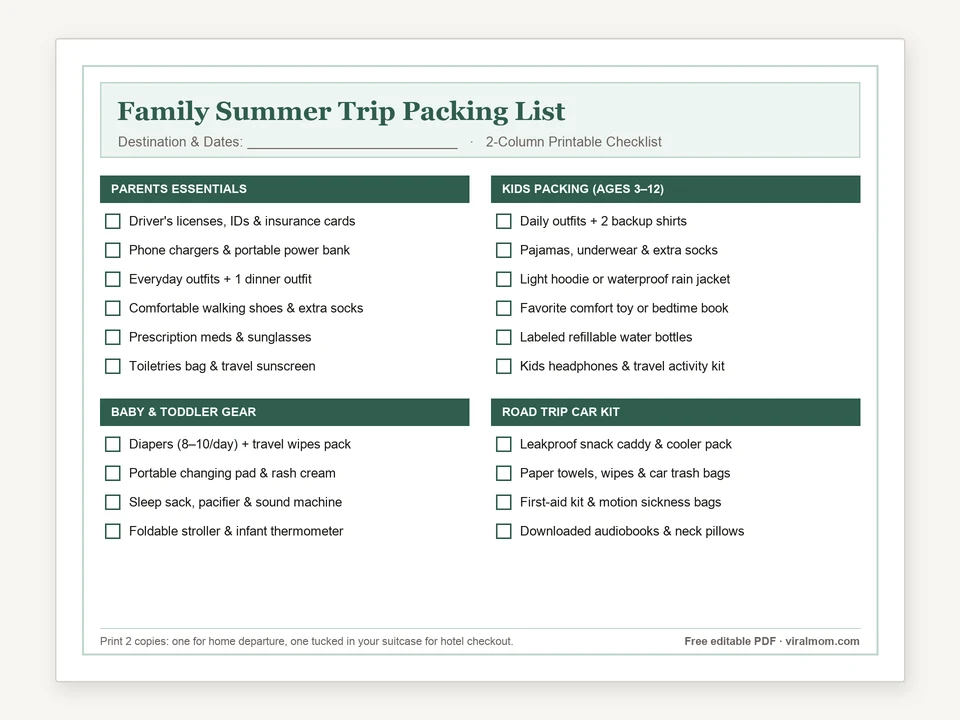
One simple rule saves families hundreds of dollars in replacement chargers, swim goggles, and hotel shipping fees: always print two identical copies of your finalized packing checklist. Keep Copy #1 on the kitchen counter as you check off every bag before loading the trunk. Fold Copy #2 into the front zipper pocket of your main suitcase so you can verify every nightlight, toothbrush, and stuffed animal before handing back your hotel keycard.
Let children ages six and up pack their own small backpack using their dedicated section of the printed checklist—with a quick parent verification pass at the end. Kids who help check off their own hoodies, pajamas, and comfort books complain far less during the drive and build real travel independence.
Free Browser-Editable Travel PDF
Customize & Print Your Family Packing List in Seconds
Toggle one-click presets for Parents, Kids, Baby, Road Trips, and Beach days—add your family’s must-haves and download a clean 2-column checkbox PDF with zero signup.
72-Hour Family Road Trip Countdown Checklist
- 01 72 hours out: Customize and print 2 copies of your Family Packing List PDF (toggle Parents, Kids, Baby, Road Trip, or Beach sections).
- 02 48 hours out: Check tire pressure (including spare), top off washer fluid, download offline maps, playlists, and kids audiobooks.
- 03 24 hours out: Shop cooler groceries anchored to your weekly USDA Food Plan benchmark and freeze reusable water bottles.
- 04 Evening before: Pack the Zone 2 First-Night Overnight Tote and load Zone 3 suitcases into the trunk so morning departure takes 10 minutes.
- 05 Departure morning: Place the Zone 1 Cabin Reach Kit in the front seat, lock doors, check thermostats, and hit the road calm.
Primary Sources & Editorial Verification
How ViralMom Verifies Sources →- USDA FNS — Official USDA Food Plans: Cost of Food at Home (Benchmark Dataset) (Verified 2026-11-22)
- U.S. National Park Service — Every Kid Outdoors Free 4th Grade Pass (Verified 2026-11-22)
- NHTSA — Car Seat & Booster Seat Road-Trip Safety Guidelines (Verified 2026-11-27)
Frequently Asked Questions
How far ahead should a family start packing for a multi-day road trip?
Print your customized packing checklist three days before departure, wash favorite kids clothes two days out, pack main suitcases the evening before, and load only the cooler and cabin snack bag on departure morning.
How much should a family of four budget for road-trip groceries vs. restaurants?
Using Official USDA Food Plans (verified 2026-11-22), a reference family of four averages roughly $34/day on the Low-Cost plan ($238/week) or $42/day on the Moderate plan ($292/week) for home/cooler groceries. Packing cooler breakfasts and picnic lunches keeps baseline food costs near that mark so you can reserve dining-out dollars for one planned restaurant meal per day.
What is the single most forgotten item on family road trips?
Multi-port USB wall chargers, children’s liquid fever reducer/thermometer, portable white-noise machines, and extra plastic bags for wet swimsuits or car sickness consistently top parents’ forgotten lists.
Can kids use the printed packing list themselves?
Yes! Kids ages 6 to 12 love taking a highlighter or pencil to the dedicated Kids Packing section on our 2-column Family Packing List PDF—just do a quick two-minute parent review before zipping their duffel.