Age-by-Age Kids Chore Chart & Morning Routine System (Ages 3–12)
Build calm mornings and lasting responsibility with our age-by-age kids chore and routine system (ages 3–5, 6–9, 10–12) plus free visual-icon printable PDFs.
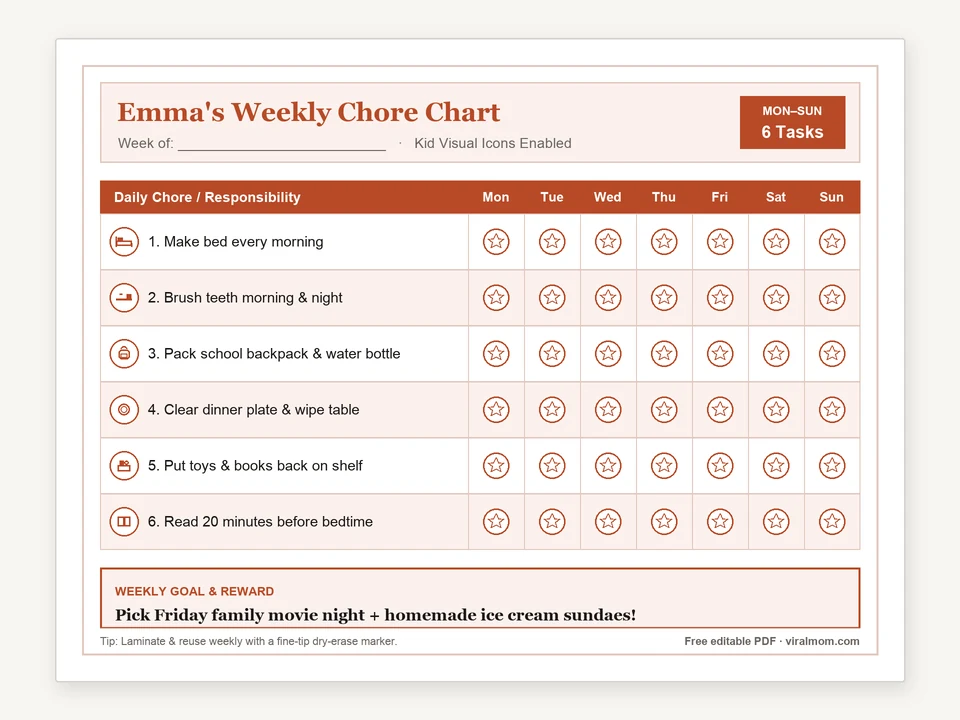
Most parents want the same two things for their children: calmer weekday mornings where nobody leaves the driveway in tears, and kids who grow up knowing how to take care of a home without waiting to be asked five times. Yet countless families print a chore list in September, feel hopeful for four days, and watch it quietly collect dust behind school flyers by October.
The missing piece is rarely willpower—it is developmental matching. A four-year-old who cannot read yet needs picture icons, two-minute physical tasks, and instant visual checkoffs; a ten-year-old needs clear ownership, predictable deadlines before screen time, and genuine trust. Below is the complete age-by-age chore and morning routine blueprint you can print and start tonight.
Why Two Separate Charts Beat One Overcrowded Master List
When parents cram "brush teeth," "put on shoes," "unload dishwasher," and "read 20 minutes" onto one massive spreadsheet, children glaze over immediately. Brain-friendly home systems separate time-sensitive transitions from weekly household stewardship:
First, post a visual Morning & Bedtime Routine Chart right where transitions happen (bedroom door or bathroom mirror). It answers "What do I do next so we catch the bus calmly?" Second, post a Weekly Chore Chart at kid eye level on the fridge. It tracks repeatable family-team habits across Monday through Friday or Monday through Sunday and ties to a Friday family reward or preteen goal.
Complete Age-by-Age Chore & Morning Routine Matrix (Ages 3–12)
Use this developmental guide to choose the right task load, visual support, and morning time cushion for each child in your house. Every preset below maps directly into our free Chore Chart Maker and Morning Routine Chart editors.
| Age Stage | Morning Routine (Steps & Time) | Daily & Weekly Chores | Best Chart Format & Motivation |
|---|---|---|---|
| Preschool (Ages 3–5) | 4–5 steps · 50–60 min cushion (wake, dress, eat, brush teeth, shoes) | 4–6 micro-chores: toys into bin, dirty socks in hamper, carry plastic cup to sink, shoes on mat, help feed pet, water plant | Kid Visual Icons ON + large Star Circles for stickers or coloring; celebrate with Friday park outing or extra bedtime book. |
| Elementary (Ages 6–9) | 6–7 steps · 45–50 min cushion (make bed, dress, breakfast, teeth/hair, pack lunchbox, shoes & backpack) | 6–8 habits: make bed, unpack lunchbox, clear & wipe table, put away folded laundry, tidy floor, 20-min reading, empty small recycling bin | Visual Icons optional + Mon–Sun checkboxes; earn Friday movie pick, pancake topping choice, or bonus 10 min free play. |
| Preteen (Ages 10–12) | 6–8 self-paced blocks · 40–45 min cushion (own alarm clock, prep lunch & water bottle, out the door on time) | 7–10 responsibilities: load/unload dishwasher, sort & start own laundry, vacuum hallway, roll bins to curb, walk dog, homework before screens | Clean checkboxes + clear "Family Team Baseline" vs. optional paid extra jobs for savings goals or friend outings. |
How Kid-Friendly Visual Icons Transform Ages 3–5 Mornings
Pediatric child-development guidance (including resources from the American Academy of Pediatrics on HealthyChildren.org) emphasizes that young children build cooperation through predictable routines and visual cues rather than repeated verbal commands. A three- or four-year-old cannot decode a sentence like "Put your pajamas in the laundry hamper," so a text-only chart forces you to read every line aloud—bringing back the exact nagging loop you wanted to escape.
With Kid-Friendly Visual Icons enabled inside ViralMom’s Chore Chart Maker and Morning Routine Chart, every step prints a crisp vector icon right beside the words (bed, toothbrush, toy bin, shirt, breakfast bowl, backpack, shoes, storybook, moon). When your preschooler finishes breakfast, you simply smile and ask, "What picture comes next on your chart?" Let the chart—not your voice—hold the boundary.
The 14-Day Launch Rule: Coaching First, Independence Second
The number-one reason chore systems stall in week two is expecting instant perfection on day one. Every new skill—making a bed neatly, wiping crumbs off a table without sweeping them onto the floor, or sorting dark and light laundry—requires two calm weeks of "do it alongside me" coaching.
- Day 1–5 (Side-by-Side): Walk through the morning routine and chores together with zero lectures. Model exactly what "done" looks like ("Shoes touching the mat, toes pointing at the wall!").
- Day 6–10 (Prompt the Chart): Instead of saying "Go brush your teeth," redirect gently: "Check step four on your bathroom chart."
- Day 11–14 (Celebrate & Trim): Review the sheet Sunday afternoon. If one task caused tears four days straight, break it into a smaller step or swap it for a better timing window.
- Protect the "When/Then" rule: Anchor screen time, playground visits, or dessert cleanly behind routine completion ("When your afternoon checklist boxes are checked, then screens turn on").
Allowance vs. Family Team Chores: Keep Money Lessons Clean
Parents often ask whether they should pay kids for every checkmark. Many family finance educators recommend a clean two-tier boundary: everyone living in the house contributes to baseline "Family Team Chores" (making their own bed, clearing their own dinner plate, picking up shared toys) simply because we help each other—celebrated with shared fun like Friday family movie night.
Once children reach ages 8–12 and want to save for sports gear, books, or gifts, add a small optional "Above-and-Beyond Job Menu" (washing the car, pulling garden weeds, sweeping the garage, folding a shared towel basket) that pays a clear per-job amount. That way kids never refuse to brush their teeth just because they already have enough allowance cash.
Free Visual-Icon Printables
Customize Your Child’s Chore Chart PDF (Ages 3–12)
Pick an age preset, enable Kid Visual Icons for pre-readers, choose star circles or checkboxes, and print or download a crisp US Letter / A4 PDF with zero signup.
10-Minute Sunday Setup for Calmer Weeks
- 01 Customize and print one Morning (or Bedtime) Routine Chart per child with Kid Visual Icons toggled On.
- 02 Customize and print one Weekly Chore Chart matched to each child’s age preset (3–5, 6–9, or 10–12).
- 03 Laminate both sheets or slip them into magnetic dry-erase fridge sleeves with fine-tip dry-erase markers.
- 04 Hang morning routines at child eye level near the bedroom/bathroom and chore charts on the refrigerator.
- 05 Hold a 3-minute Sunday family kickoff to pick this week’s Friday family reward together.
Primary Sources & Editorial Verification
How ViralMom Verifies Sources →- American Academy of Pediatrics (HealthyChildren.org) — The Importance of Family Routines (Verified 2026-11-27)
- CDC — Essentials for Parenting Toddlers and Preschoolers (Structure & Routines) (Verified 2026-11-27)
Frequently Asked Questions
At what age can a child start using a printable chore chart?
Children can start enjoying a simple 4- to 5-item visual chore chart around age 3. Enable Kid-Friendly Visual Icons and Star Circles so pre-readers see the picture cue (toys, hamper, toothbrush, shoes) and place a sticker or star inside each finished circle.
Should a morning routine chart be separate from a chore chart?
Yes. Putting morning self-care transitions (get dressed, breakfast, teeth, shoes) on a bathroom or bedroom door chart keeps weekday departures calm, while a separate refrigerator chore chart tracks weekly household contribution.
What if my child stops caring about their chore chart after two weeks?
Refresh the weekly family reward together on Sunday, trim the chart to 5–7 winnable habits, and make sure you are letting the child check off boxes right away with a fun dry-erase marker or star stamp.
Can I print different charts for siblings in different age groups?
Yes! Load the Ages 3–5 preset for your preschooler and print or save the PDF, then click Ages 6–9 or Ages 10–12 for an older sibling and download a second sheet—unlimited free edits with no login.